
Even with careful pricing, it’s hard to protect your margins in today’s market. Material prices move, labor runs long, and clients change their minds. Yet fixed prices don’t move with them.
A cost-plus building contract is how many builders deal with that reality. Instead of guessing costs upfront and bearing the risk, you price the job as it happens, with clear rules around what gets charged and how you’re paid.
This guide breaks down how cost-plus building contracts actually work on residential builds, when they make sense, and where builders get caught out. We examine how they compare to fixed-price contracts and what you need to manage them effectively.
What Is a Cost-Plus Building Contract?
A cost-plus building contract is an agreement where the builder is reimbursed for the costs of a project, like materials and labor, plus an agreed profit for running the project. That profit is usually set as a fixed fee or a percentage of the total costs.
Rather than setting a single fixed price at the start, a cost-plus contract ensures your agreed fee stays consistent even as costs change. It’s especially useful when the scope isn’t fully defined upfront or when costs are likely to change during the build.
Elements of a Cost-Plus Contract
Understanding the key components and language of a cost-plus construction contract is crucial:
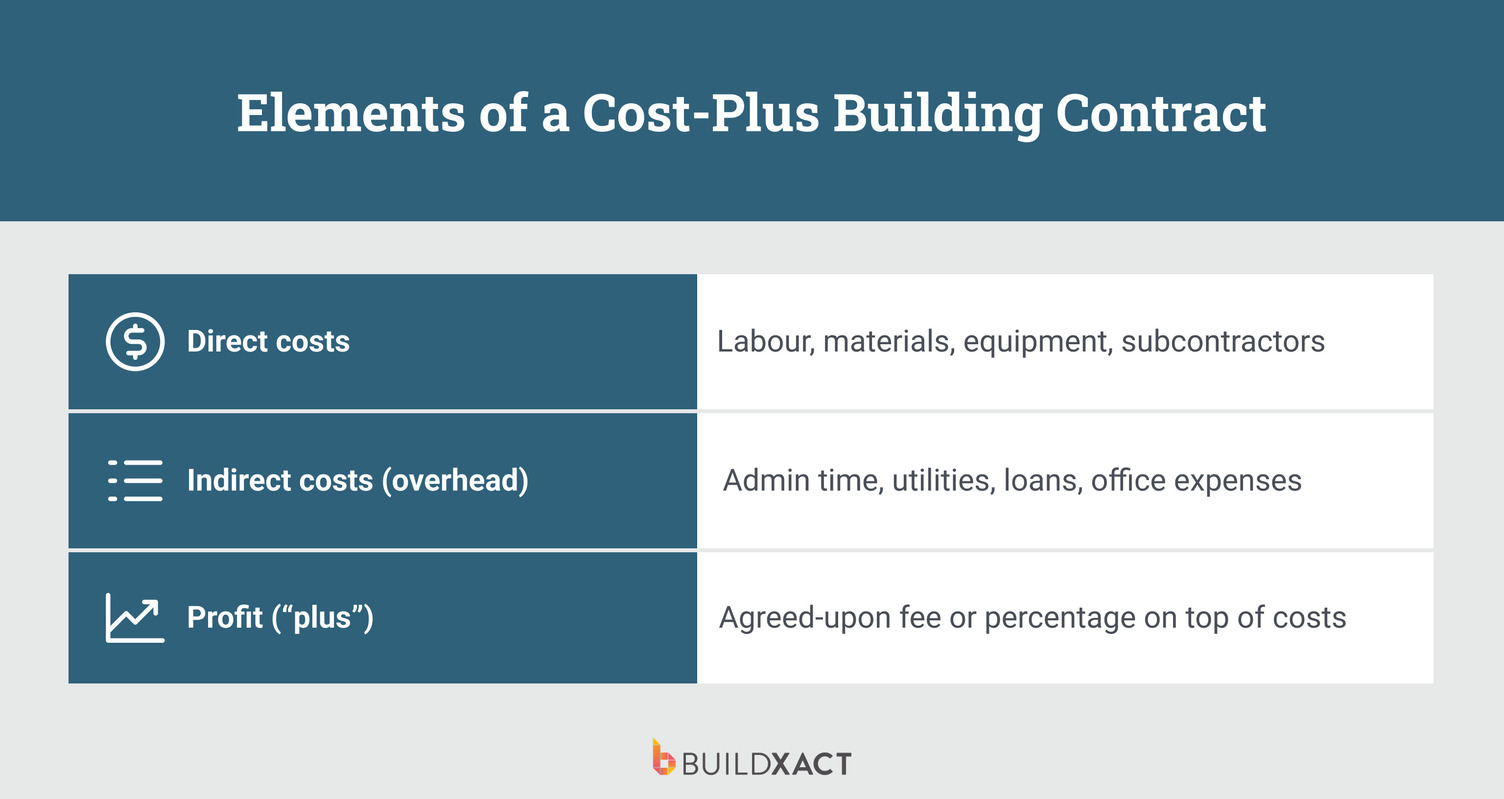
Direct costs
These encompass labor, materials, equipment or subcontractor fees directly associated with the project. Think of it as paying for the individual puzzle pieces that form the whole.
Indirect costs/ overhead
These are expenses related to running the business, such as administrative hours, loans, utilities and general office expenses. They support the business as a whole – like paying for the time spent assembling the puzzle or the table used for holding the pieces.
Profit
After reimbursing project costs, the additional fee, or “plus,” calculated as a percentage of total allowable costs, represents profit. This should be viewed as an investment in future business growth. True profit, or net income, comes only when all expenses, depreciation, and salaries have been accounted for.
Flexibility and reduced risk are the primary advantages that cost-plus contracts offer builders or contractors, especially in markets prone to price fluctuations. Unlike fixed-price contracts with predetermined costs, cost-plus contracts reimburse expenses as they occur and offer an agreed-upon fee for profit. With this, you can better focus on quality rather than cost-cutting.
How Cost-Plus Building Contracts Work in Practice
Cost-plus construction contracts reimburse for project costs, including labor, materials and overhead. Alongside these costs, there’s a predetermined profit margin that is a percentage of total project costs and delivered as markup.
To keep everything running smoothly, cost-plus jobs usually follow a simple process:
1. Costs are captured as the job progresses
Materials are logged as they’re ordered and received, and labor or subcontractor work is recorded as it’s completed.
Capturing costs in real time is crucial, especially in environments with rising costs. When prices change mid-build, waiting until the end of the job increases the risk of missed costs, invoice pushback, and lost profit.
2. Invoices clearly show itemized costs and markup
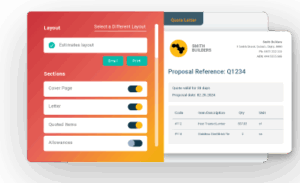
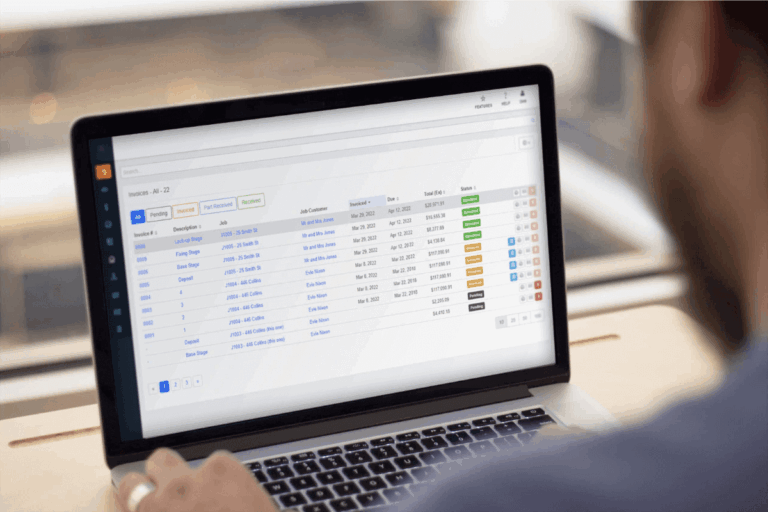
Customer invoices itemise project costs alongside the agreed markup, so clients can see exactly what they’re paying for. This clarity reduces pushback and avoids confusion when totals change.
3. Approvals are handled as scope or costs change
When price variations, upgrades, or unexpected site conditions come up, costs are reviewed and approved along the way, not argued about months later.
4. A complete audit trail is maintained
Every cost, approval, invoice, and payment is recorded and traceable. When estimating, job costing, and accounting are all connected, this audit trail stays accurate automatically. It’s easier to stay compliant, answer client questions, and keep financial records aligned without extra admin.
However, customers will still need an overall cost estimate. Accurate estimating systems are vital to arrive at a clear total budget or cap, free of the potential errors that could erode anticipated profits.
Cost-Plus vs. Fixed-Price Contracts
The real difference between cost-plus and fixed-price contracts comes down to who carries the risk when things change.
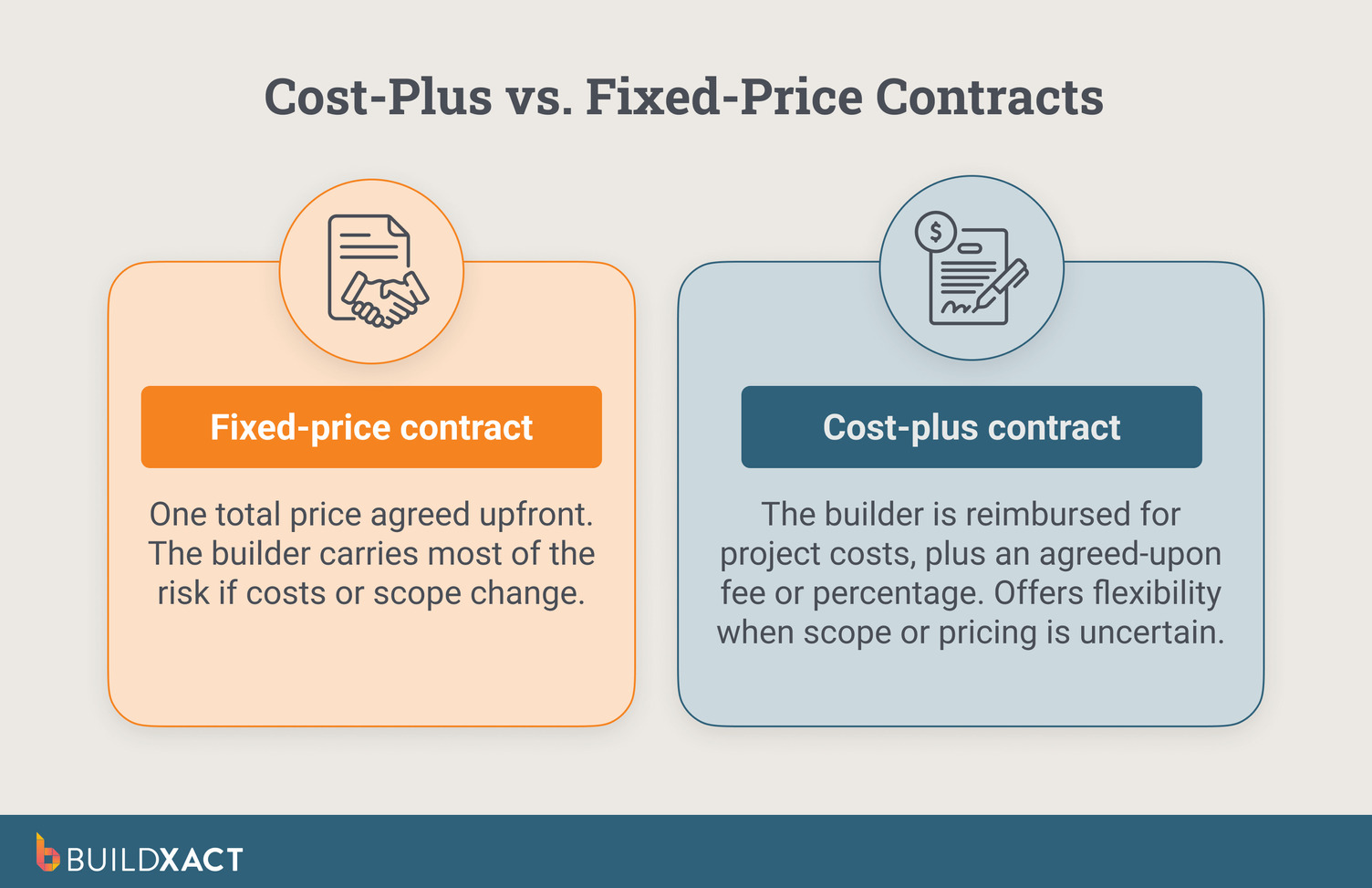
- In a fixed-price contract, the price is set before work begins. That can feel safer for the client, but for builders, it means price increases, delays, or scope changes often come straight out of your pocket.
- Under a cost-plus contract, costs are tracked as the job progresses. The client pays the actual costs, plus your agreed fee. Cost-plus contracts offer flexibility and peace of mind amid uncertainties, but often require more detailed customer invoicing to explain ongoing costs.
Advantages of Cost-Plus Building Contracts
These are the upsides that make cost-plus worth considering:
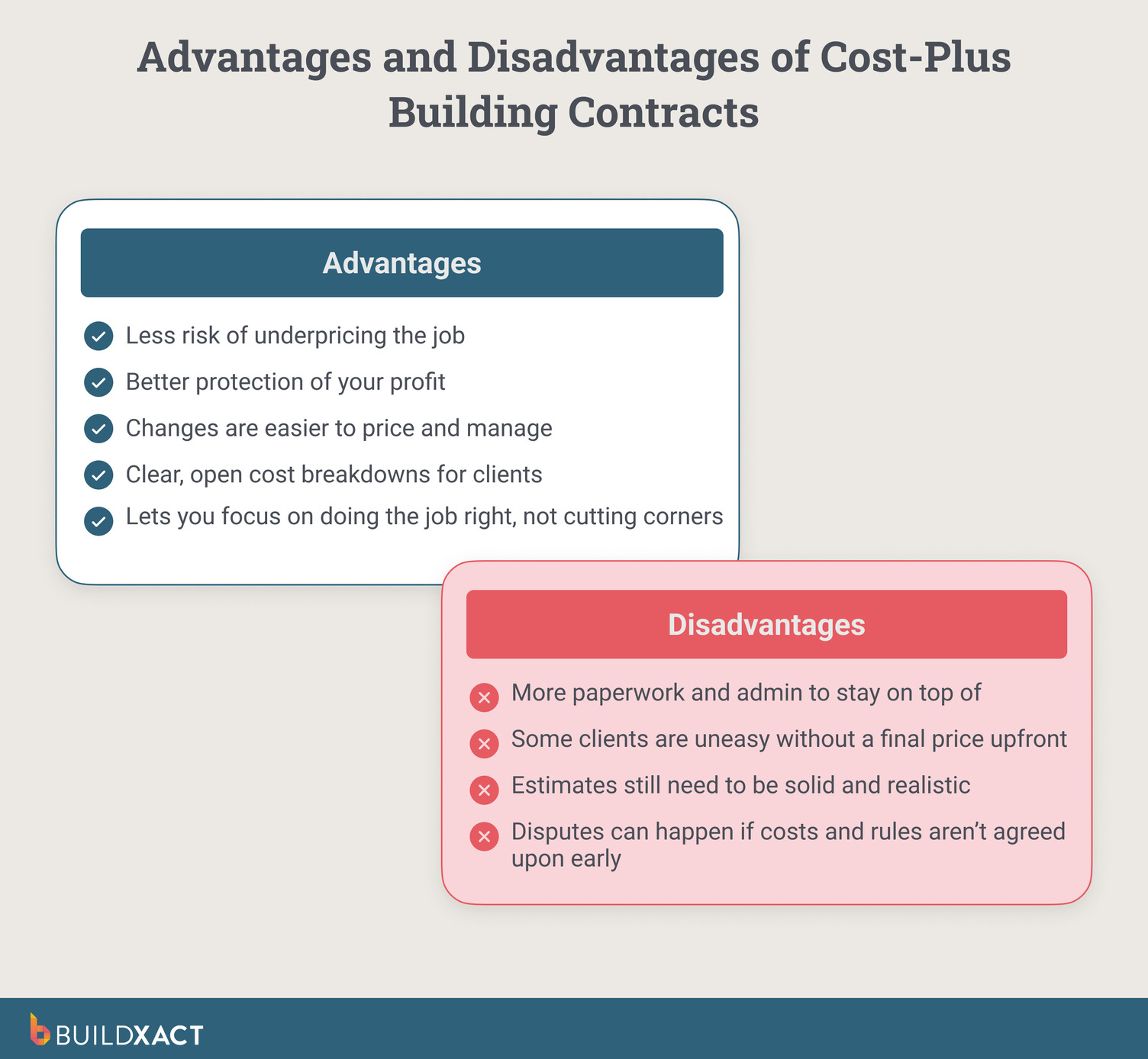
- Lower risk of underpricing the job – You’re not guessing future costs and hoping for the best. If prices change, you’re covered.
- Better protection for your margin – Your profit isn’t slowly eaten away by rising material prices or longer labor time.
- Changes are easier to manage – Variations don’t derail the job. They’re documented, approved, and billed as they happen.
- Clear cost visibility for clients – Clients can see where the money is going, which helps build better customer relationships and avoids “why is this so high?” conversations later.
- More freedom to build properly – You can choose the right materials and do the job right, instead of cutting corners to protect a fixed price.
Drawbacks of Using Cost-Plus Building Contracts
When considering a cost-plus contract, there are some cons to be aware of:
- More admin to stay on top of – Cost-plus only works if costs are tracked properly. Without good processes, paperwork can pile up fast.
- Some clients are uneasy without a final price upfront – Not everyone is comfortable without a fixed price, so expectations need to be set early.
- You’re constantly justifying numbers – Because costs are visible, any gap between the project cost estimate and actual spend invites questions. Weak estimates make those conversations harder.
- Disputes can happen if costs and rules aren’t agreed upon early – If “allowable costs” or markups aren’t clearly defined in the contract, disputes can crop up later.
When to Use a Cost-Plus Construction Contract
Cost-plus isn’t something you should use by default. It’s a tool you pull out when certainty is low, and risk needs to be shared.
Cost-plus makes sense when:
Scope is undefined or evolving
If plans, selections, or engineering details aren’t fully locked in, cost-plus is a good idea. Pricing a fixed contract at this stage often means guessing, and that guess shifts the financial risk onto you.
Ask yourself: Am I confident I can lock in prices without padding the quote?
You’re working on renovations or custom homes
If unknowns behind walls, below ground, or within existing structures are likely, cost-plus helps protect you from absorbing every surprise as the job unfolds.
Ask yourself: How much risk am I willing to carry if costs or timelines shift?
There’s a high chance of change orders
If client decisions are likely to shift once construction starts, cost-plus allows change orders to be documented, approved, and billed clearly, rather than constantly reworking prices.
Ask your client: Are you willing to approve changes and costs as the build progresses?
Material pricing is volatile
If the price of materials shifts between quoting, ordering, and delivery, locking in a fixed price too early puts you in a tough spot. Cost-plus lets pricing adjust as costs change, without your margin taking the hit.
Ask yourself: Would a fixed price force me to cut corners to protect my margin?
Other Types of Cost-Plus Construction Contracts
“Cost-plus” just means the client covers costs, but how you get paid on top of that can vary a lot.
The fee structure you choose affects everything from cash flow to client trust. Some builders keep it simple, while others build in incentives or performance bonuses.
These are the cost-plus contract types you’ll see most often in residential construction.
Cost-Plus-Fixed-Fee
Here, you’re reimbursed for allowable costs during the project with a fixed fee added if needed.
Cost-Plus-Incentive-Fee
Reimburse you for costs with an agreed-upon fee; however, if you keep costs below that agreed-upon fee, you may receive a share of the cost savings.
Cost-Plus-Percentage-of-Cost
While used less today, it still offers flexibility, but many builders avoid it because your fee increases with higher project costs, making a project less cost-efficient.
Cost Plus Award Fee (CPAF)
It is a slightly riskier contract because it is performance-based. This type of agreement offers the contractor reimbursement for work completed and additional compensation for outstanding performance of work.
Common Risks in Cost-Plus Building Contracts (And How to Avoid Them)
Cost-plus contracts give you flexibility, but they also remove the safety net. If the details aren’t tight, cracks show fast.
Here are the most common pressure points builders run into on cost-plus jobs and what keeps them from becoming problems.
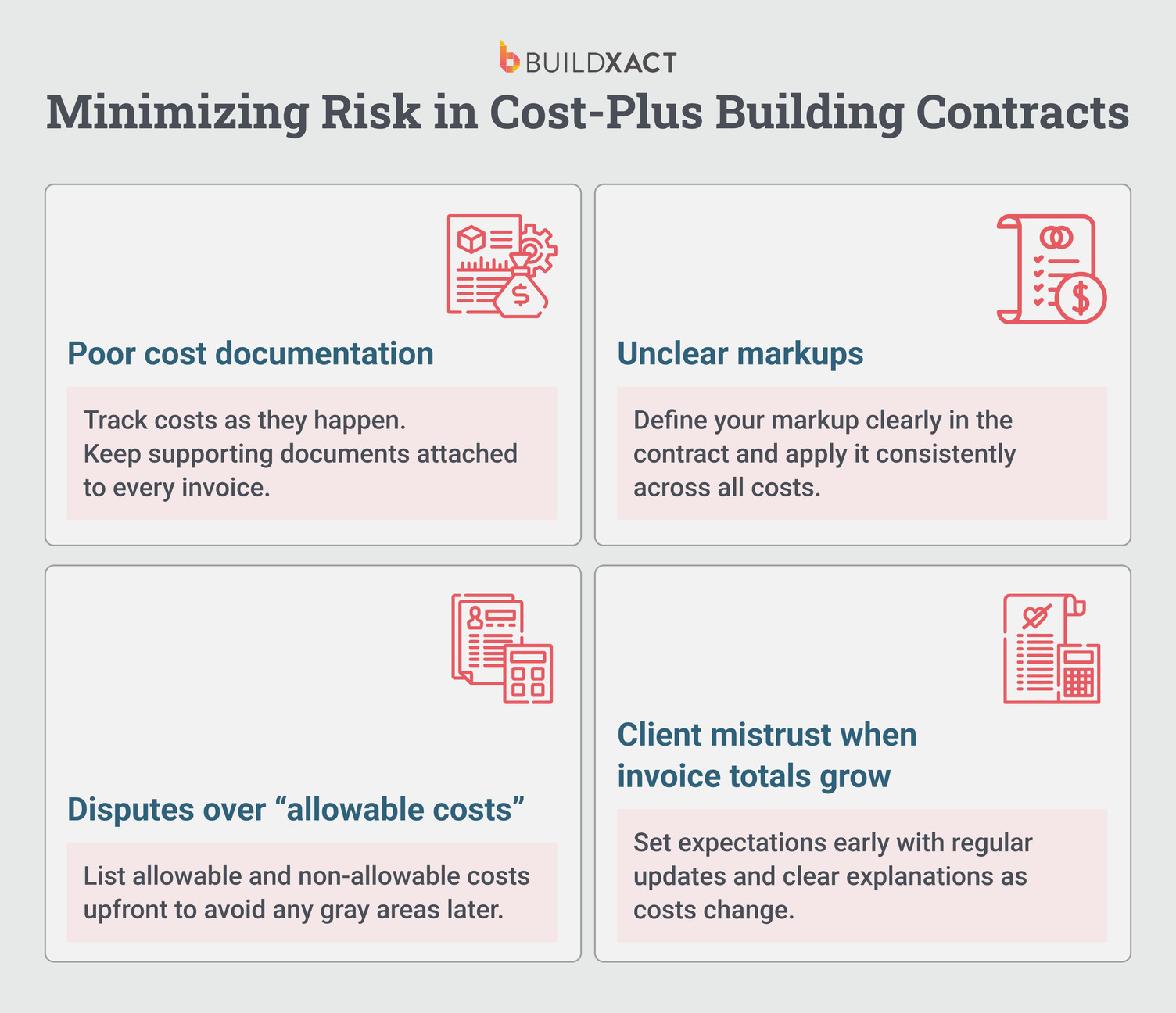
Poor cost documentation
If costs aren’t captured as they happen, things can get messy. Missing receipts or late entries make it harder to back up your invoices. You end up wasting time explaining numbers instead of getting on with the job.
Builders who stay on top of their finances capture costs as materials are ordered and as work is completed.
Using a system that links purchase orders and work orders directly to the job means every cost is recorded once and automatically flows through to job costing and customer invoices without scrambling at billing time.
Unclear markups
If your client doesn’t understand how your fee works, questions start popping up. Inconsistent or poorly explained markups can chip away at trust, even when the work on site is solid.
When your markup rules are clear and consistent, invoices speak for themselves. In Buildxact, you choose whether a job is cost-plus or fixed-price from the start, and you can apply markup rules at the job level or adjust them per line item. That clarity carries through to every invoice.
Builders who define their cost-plus percentages early don’t have to re-explain their fee on every invoice.
Disputes over “allowable costs”
Cost-plus only works when everyone agrees on what qualifies as reimbursable. If those rules aren’t clearly defined in the contract, clients may question certain charges later, especially admin time or subcontractor-related costs.
To prevent this, be explicit in the contract, then back it up with clear documentation that’s accessible for all stakeholders. Buildxact-generated invoices pull directly from purchase and work orders, making it easy to show exactly what’s been charged and why, without manually rebuilding invoices each time.
Client unease as invoices grow
On longer jobs, invoices naturally add up. Without early context around the likely range or total cost, some clients get nervous, even when everything is transparent.
One way builders manage this uneasiness is with a Guaranteed Maximum Price (GMP), which makes cost-plus feel more like a fixed-price contract. A GMP sets a maximum price for a project, holding the contractor accountable for costs exceeding the threshold. While advantageous, underestimating costs in a GMP can lead to losses.
Where Software Ties It All Together
Most cost-plus risks stem from manual handling: double entry, missed costs, unclear invoices, or disconnected systems. But when estimating, purchasing, job costing, invoicing, and accounting live in a single workflow, those risks shrink quickly.
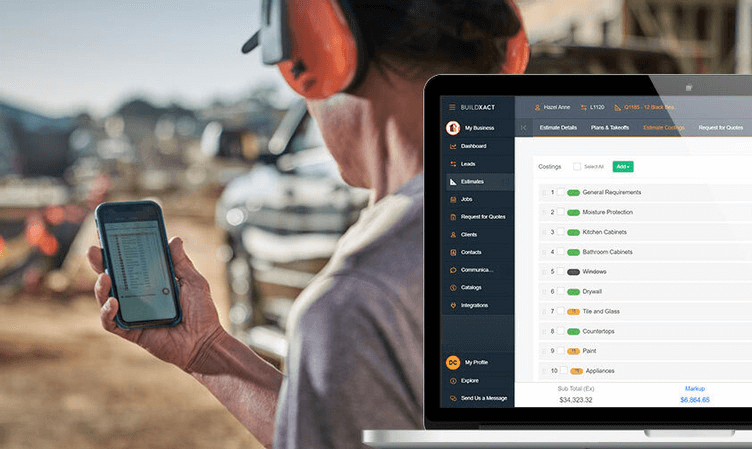
With Buildxact’s two-way accounting integration, job costs flow straight from site to invoice to top accounting software like QuickBooks or Xero. Because purchases and invoices sync back to the original estimate tasks, you always have a clear view of actual costs versus budget as the job progresses.
That means fewer surprises at billing time and less admin chasing your own numbers. You’ve got a clean trail from estimate to final invoice, which makes cost-plus jobs easier to manage and a lot easier to explain to clients when questions come up.
If cost-plus is part of how you protect your margins in today’s market, having the right systems in place matters just as much as the contract itself.
Schedule a demo today with a Buildxact team member for a one-on-one conversation. Or if you’re ready to jump in, sign up for free to see just how powerful construction management software can be.